
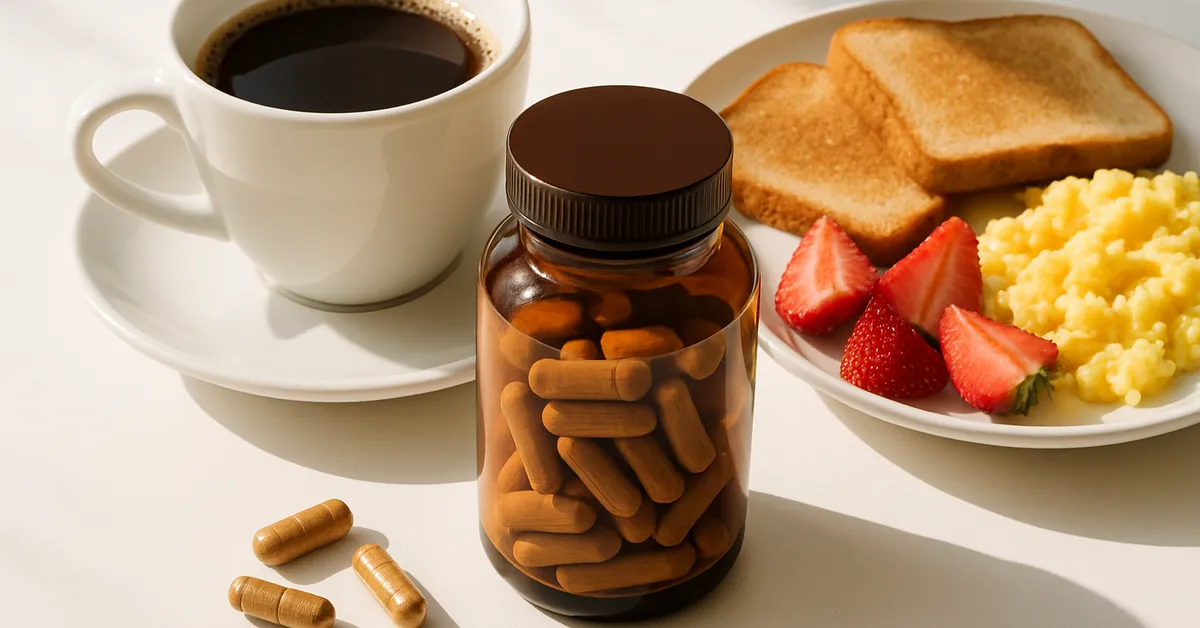
Why Timing Actually Matters for Cinnamon Supplements
Most supplements you can take whenever is convenient and not lose much. Cinnamon is different. Its primary mechanism in the body is closely tied to blood sugar regulation and insulin response, which means timing relative to meals genuinely changes how well it works.
Disclosure: This post contains affiliate links. We may earn a commission if you purchase through our links, at no extra cost to you. We only recommend products we trust.
This isn’t speculation. The studies that showed cinnamon’s effects on blood sugar and related markers largely used specific timing protocols. Understanding what they did, and why, gives you a smarter approach than just “take it sometime during the day.”
The Core Mechanism: Why Meals Are the Anchor
Cinnamon’s most well-documented effect is improving insulin sensitivity and slowing gastric emptying. Here’s what that means in practical terms:
When you eat carbohydrates, they break down into glucose. Your pancreas releases insulin to shuttle that glucose into cells. If you’re insulin resistant, your cells don’t respond well to insulin’s signal, glucose stays elevated longer, and your pancreas pumps out more insulin to compensate. This is the foundation of prediabetes, type 2 diabetes, and a cluster of metabolic problems.
Cinnamon appears to enhance insulin receptor sensitivity and stimulate glucose transporters, which means cells respond better to insulin’s signal. It also slows the rate at which food leaves your stomach, which flattens the glucose spike after eating.
The timing implication is obvious: these effects are most relevant when glucose is actually entering your bloodstream, which means around meal time. Taking cinnamon at 3am accomplishes very little.
The Case for Taking Cinnamon With Meals
The strongest evidence for cinnamon’s blood sugar effects comes from studies where it was taken with or immediately before meals. A meta-analysis examining cinnamon’s effects found that blood sugar and blood pressure improvements were most consistent when supplementation was paired with meals, particularly in people with prediabetes or type 2 diabetes.
Taking cinnamon with a meal gives it the best opportunity to:
- Slow gastric emptying as food is being processed
- Enhance insulin receptor signaling during the period when glucose is rising
- Reduce post-meal (postprandial) glucose spikes
There’s also a practical advantage: pairing it with a meal means you’re less likely to forget it. Building the habit around eating is easier than remembering a standalone timing cue.
Morning vs Evening: What the Research Suggests
Most people’s largest glucose challenge happens at breakfast and lunch, especially if those meals include refined carbohydrates. A morning dose with breakfast makes biological sense for blood sugar reasons.
Some research also suggests that insulin sensitivity fluctuates throughout the day, tending to be highest in the morning and lower in the afternoon and evening, a phenomenon driven by circadian rhythm and cortisol patterns. This is another argument for getting cinnamon in earlier in the day when your body is best positioned to use it.
Evening dosing isn’t without logic, though. Your dinner meal may be your largest, and a dose with dinner still helps flatten the post-meal glucose response. For people eating later at night, this could be the most practically useful dose of the day.
The honest answer from the available research: morning with breakfast and evening with dinner are roughly equivalent in terms of which is “better.” Both are superior to taking it in a random window unconnected to meals.
Split Dosing: The Best of Both Worlds
If you’re taking a standard supplement dose of 1,000-2,000mg daily, splitting it into two doses (morning and evening) is likely better than taking it all at once. Here’s why:
- You get blood sugar support around two major meals instead of one
- Smaller individual doses are better tolerated in the GI tract
- More consistent presence of active compounds throughout the day maintains steadier effects on blood pressure and metabolic function
This is the protocol used in many of the clinical trials that showed significant blood pressure reductions: split dosing over 8-24 weeks consistently outperformed single daily doses in meta-analytic comparisons.
A practical split-dose approach: 500-750mg with breakfast, 500-750mg with dinner. That puts you at 1,000-1,500mg daily, right in the therapeutic range from human studies.
For the full breakdown on how much to take daily, see: how much cinnamon should you take per day?
Ceylon vs Cassia: Timing Has a Different Implication for Each
This is where the Ceylon vs Cassia distinction goes beyond just safety profiles. The coumarin content of Cassia creates a specific timing consideration that Ceylon doesn’t have.
Coumarin, the compound found in high amounts in Cassia cinnamon, is processed by the liver. At higher doses taken regularly, it accumulates and can cause liver toxicity. The European Food Safety Authority has set a daily tolerable intake for coumarin at 0.1mg per kilogram of body weight, which for an average adult is about 6-7mg. A teaspoon of Cassia powder can contain 5-12mg of coumarin, meaning daily supplemental doses of Cassia can easily push you over safe limits.
If you’re using Cassia, this means: lower doses, less frequent use, and spreading the dose to avoid overwhelming the liver’s processing capacity. This is why Cassia was originally used in research at specific doses that were kept within coumarin limits.
Ceylon cinnamon has virtually no coumarin. This means you don’t have to worry about liver load or coumarin accumulation regardless of how you time your doses. You can take it consistently every day without those constraints. For daily supplementation with optimal timing flexibility, Ceylon is simply the better choice.
The MFL article on blood sugar mechanisms is a good companion read: cinnamon and blood sugar. For the broader picture on diabetes management: cinnamon for diabetes: can it help manage blood sugar?
Capsules vs Powder vs Tea: Does the Form Change the Timing?
The form you’re using slightly changes how you think about timing.
Capsules
The most practical form for precise dosing. Take with a glass of water with your meal. Capsules dissolve in the stomach and release the extract, so timing effects are straightforward. This is the recommended form for people using cinnamon therapeutically.
Powder (Stirred Into Food or Drink)
Can be stirred into oatmeal, yogurt, smoothies, or coffee. Effective if you’re consistent, but dosing is less precise. If you’re using a measuring spoon, one teaspoon of Ceylon powder is roughly 2,500mg, which is actually a higher dose than most capsule products. For blood sugar purposes, mixing powder directly into a carbohydrate-containing meal may have the advantage of physical mixing with food in the gut.
Cinnamon Tea
Pleasant, but the bioavailability of cinnamon compounds in tea is lower than in powder or extract form. If you’re using tea for blood sugar and blood pressure effects, you need to be realistic: you’re getting far less active compound per cup than from a supplement. Tea is fine as a supplemental habit alongside capsules, but it’s not a replacement if you want therapeutic doses.
A Practical Daily Schedule
Here’s a concrete routine based on the evidence:
- Morning: Take 500-750mg Ceylon cinnamon capsule with breakfast. Breakfast should ideally include some protein and fiber to slow glucose absorption. This sets you up for stable blood sugar through the morning.
- Lunch: Optional third dose if you’re at the higher end of the therapeutic range (2,000mg/day protocol). Take with your meal.
- Evening: Take 500-750mg with dinner. This covers your last major carbohydrate load of the day and may contribute to overnight metabolic stability.
If you want a simple two-dose approach, morning with breakfast and evening with dinner is the optimal version. Consistent timing relative to meals matters more than whether it’s 8am or 9am.
What Happens If You Miss a Dose
Don’t double up. Just take your next scheduled dose at the usual time. Cinnamon’s effects are cumulative over weeks and months, not dependent on any single day. Missing a dose occasionally doesn’t meaningfully set you back.
The bigger risk is inconsistency over time. People who take their cinnamon supplement “when I remember it” rather than building it into a meal routine tend to miss more doses and see less benefit. The meal anchor makes this much easier to stick to.
The Bottom Line on Timing
With meals is the non-negotiable rule. Split dosing twice daily (morning and evening with food) is the best approach for consistent blood sugar and blood pressure support. Ceylon is the right choice for daily use due to the coumarin-free profile. Capsules are the most practical form for consistency.
Give it 8-12 weeks and track your blood sugar or blood pressure readings if you’re using it therapeutically. The effects won’t be dramatic in week one, but consistent use at the right time and dose can deliver real benefits.
A certified organic Ceylon cinnamon supplement or also on Amazon gives you the coumarin-free, standardized dosing that makes all of this timing optimization actually work.